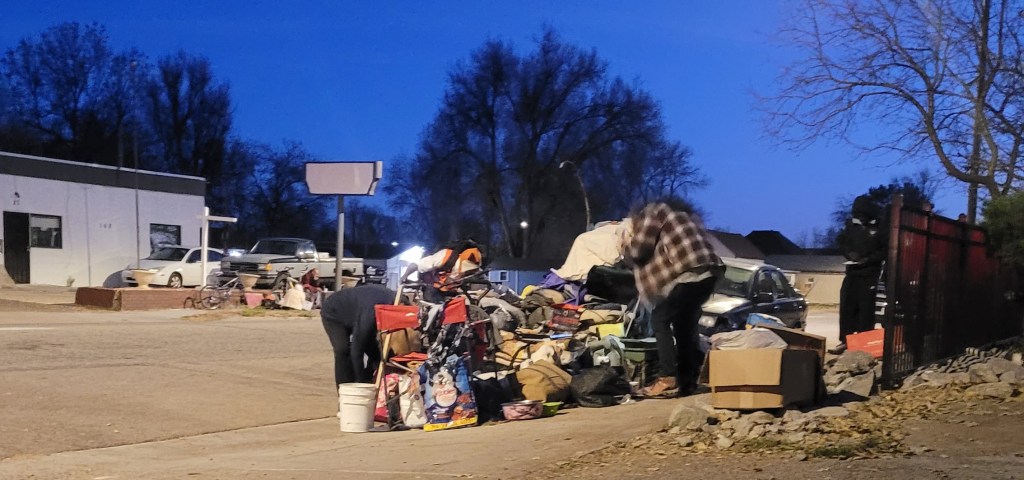
Busting Myths about Homelessness
Homelessness is a Choice
Homelessness is Intersectional
There are actually many real social/ structural/ psychological/ medical/ circumstantial reasons that people go homeless.
Speaking from my own experience I’ve gone homeless because I had to escape abuse. I had asked my school counselor for help and all that did was tell my abusers I was talking. So I had to flee home with nothing. Nobody to cosign on a place. No job references.
I went homeless when my ex-husband spent our rent money on meth. He had a roof over his head because he shot at people in the house then used our child as a human shield when the SWAT team came. I found out the next day that all of the money was gone, and it was just me and 3 kids getting evicted.
I had been trying to leave the relationship for years, but had no means on my own.
Once you’re listed on an eviction, it really impacts your ability to get a place. That was the only place I’d ever been on a lease, because I was never listed as a renter until then. I had worked with him as my supervisor for 5 years, but when they transferred him they said it would be seen as nepotism to transfer me to, so I just had to give up my employment.
No cosigner. No income. Three Kids. No Family.
I could keep going- and intend to as I continue to tell my story as a survivor. These are just two examples from my life.
Invisiblepeople.tv draws similar conclusions from an annual survey of the US Conference of Mayors, citing:
- Lack of affordable housing
- Unemployment
- Poverty
- Mental illness and the lack of needed services
- Substance abuse and the lack of needed services
Council for the Homeless agrees.
Some of the obstacles that may lead people to experience homelessness include: Experiencing homelessness as a child or teen, a lack of affordable housing for people with low to very low income, job loss or death of the household breadwinner, or one large unexpected expense, like a medical crisis, which makes it difficult to maintain independent housing.
Homeless People Don’t Want to Work
Many unhoused people have jobs
It’s just untrue.
I went homeless in 2014, because I accepted a GM in training position with Papa Johns, and although the pay wasn’t great, they were the only interview that said yes. The GM tasked with training me took it personally, because he thought I was there to push him out. He refused to train me. (My hands are shaking remembering it all.)
Instead of training me, he gave me the crappiest driver shifts, and the routs that his money-makers didn’t want, because they were too time consuming to get to, or historically didn’t tip.
I couldn’t support the 2 teenagers I had at that point, and we lost housing. The regional supervisor offered me a position at a failing store, where he was going to train me himself as we turned it around. He said the office staff would help me find housing.
I believed him.
I did not receive the training, and was living in the back of the Longmont Papa Johns, making a bed on the floor, sleeping under the overnight lights, and showering in the mop drain.
I worked from 5 am until 2-3 the next morning for $600/ week, which they revoked after a month. After, uprooting myself for this opportunity, the returned me to training pay.
I had to move my teen girls in with the only option I’d found, because I was ALWAYS working (the store ran 11% productivity the night before I got there), and the office never looked for housing for me. Within a week he let me know he expected payment and wasn’t interested in money.
There is also extensive writing about The Working Poor.
According to nestcommunityshelter.org
National data from the United States Interagency Council on Homelessness indicates that as many as 40-60% of people experiencing homelessness in the United States have a job, but housing remains unaffordable because wages have not kept up with rising rents.
Council for the Homeless points out that homelessness itself is a significant barrier to employment.
The National Alliance to End Homelessness states,
The truth is that many do (have jobs) – in fact, a 2021 study from the University of Chicago estimates that 53% of people living in homeless shelters and 40% of unsheltered people were employed, either full or part-time, in the year that people were observed homeless between 2011 – 2018.
Homeless People Are Drug Users and/ or Mentally Ill
only about a quarter of the unhoused use substance or experience mental illness
Surviving homelessness has required constant mental acuity. The entire day is spent problem solving, and securing basic needs.
It’s thinking you’ve found a solution, so your teens don’t have to live in the Papa Johns or the van which holds all of your possessions. It’s getting a storage unit, which costs about what you would be able to afford in rent, and taking hours to make it sleepable. It’s stacking your items so your kid can climb up to hang flashlights from the exposed rafters, then restacking them to make a bedroom.
It’s introducing your teens, who have periods, to a makeshift bedpan. And having to come together to create a plan for the disposal of that bedpan without getting caught.
It’s realizing while they fall asleep that if they notice your lock is dummy locked, they might just lock it to help you, and you could all die in here. It’s knowing you have no way to charge your phone, and nobody knows you’re there- that’s the only way you’re allowed to exist.
You don’t sleep because you’re listening for every noise as a possible danger that must be assessed, and waking your kids hours before anybody will be on the property, to close it all down and pack up for the day. It’s taking 5 minutes sink baths at the 711, and having them do their homework while you get the store up and running.
There’s no room in that to drop your guard- not even in your sleep.
Nevertheless, “A 2018 study revealed that 88.2% of people surveyed believed that mental illness contributed to homelessness, with another 88.4% viewing drug and alcohol abuse as the main contributor.” (invisiblepeople.tv)
In reality, about 26% of the homeless population abuse substance, and about 25% are mentally ill (invisiblepeople.tv).
Council for the Homeless reminds us that,
Homelessness, which is usually accompanied by loss of income, isolation, and loss of self-worth, may drive people to use addictive substances to ease pain, quiet fears, and generally cope with the demands of living without a permanent home. It is often mistakenly assumed that people experiencing alcoholism and drug use lack moral principles or willpower and that they should simply choose to change their behavior. Recovering from addiction is difficult for housed people; it is even more difficult for people experiencing the additional trauma of homelessness.
Nevermind that the government creates addiction in us on purpose.
It’s Too Expensive to House Homeless People
Homelessness itself is expensive
And there is so much evidence about this that you should be suspicious of anybody who tries to tell you otherwise.
Housing First is Fiscally Responsible.
I previously wrote about the Cost of Homelessness, and the reality is that emergency/reactive approaches are truly expensive. Proactive/sustainable approaches are not.
Homelessness isn’t Solvable
Solutions Exist- and they all start with housing
There are so many solutions out there. We live in a time when innovative solutions have been tried, and we have real-time results to look at.
According to the United States Interagency Council on Homelessness:
Strategy 1: Reduce housing instability for households most at risk of experiencing homelessness by increasing availability of and access to meaningful and sustainable employment, education, and other mainstream services, opportunities, and resources.
(There’s significant evidence that Loveland has chosen the opposite.)
Strategy 2: Reduce housing instability for families, youth, and single adults with former involvement with or who are directly exiting from publicly funded institutional systems.
(My friend Neaki Moss has written extensively on the foster care-homelessness pipeline.)
Strategy 3: Reduce housing instability among older adults and people with disabilities—including people with mental health conditions and/or substance use disorders—by increasing access to home- and community-based services and housing that is affordable, accessible, and integrated.
Strategy 4: Reduce housing instability for veterans and service members transitioning from military to civilian life.
Strategy 5: Reduce housing instability for American Indian and Alaska Native communities living on and off tribal lands.
Strategy 6: Reduce housing instability among youth and young adults.
Strategy 7: Reduce housing instability among survivors of human trafficking, sexual assault, stalking, and domestic violence, including family violence and intimate partner violence.
The Johns Hopkins Bloomberg School of Public Health has released its answer to “What Would It Take to End Homelessness in America?”
“We know that homelessness is a housing problem,” Soucy says. “The Government Accountability Office has shown that when median rents increase in a community, homelessness also increases in that community.”
It takes HOUSING. Housing first.
Housing first has been shown to reduce veteral homelessness by 47%.
Johns Hopkins also tells us , “An even more cost-effective approach to homelessness is to prevent it from happening.”
So, Why the Misinformation?
Many of these ideas are rooted in classism and racism. These perspectives have been touted by people who don’t do the research, before making claims. They simply make the claims that suit their purposes, and focus on saying it convincingly enough.
In short, those who spread this misinformation benefit from continuing the problem. Keeping people homeless is expensive, and people are making money off of it.
















 Operation **Reclaim** Loveland
What do you think?