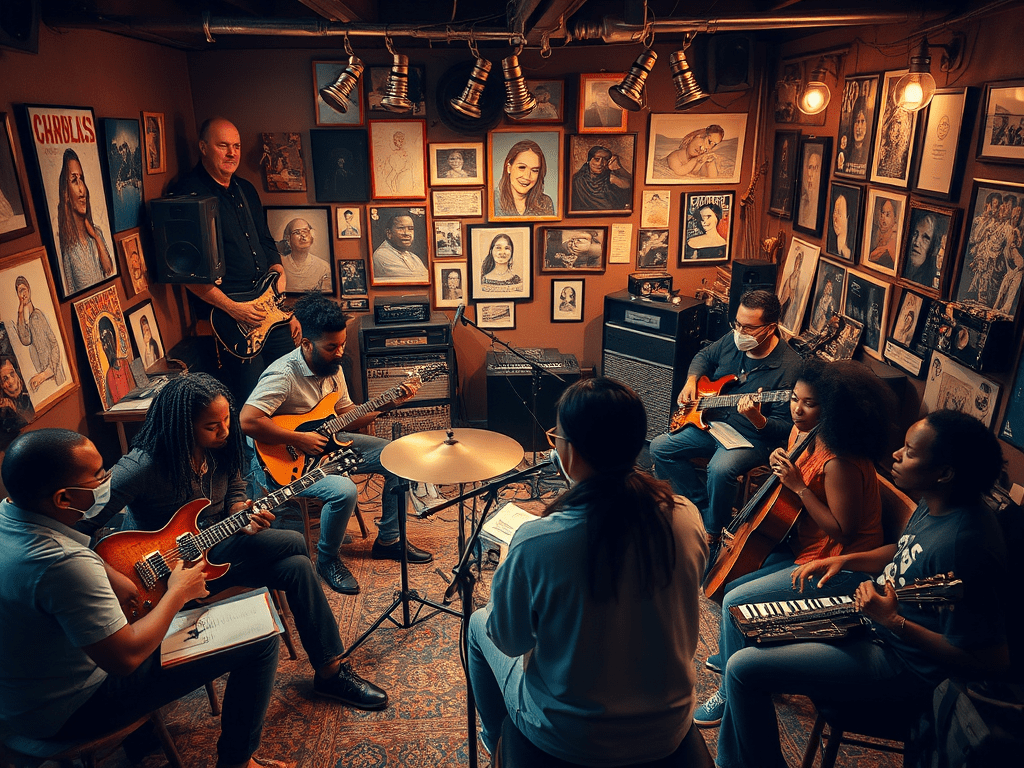
Behind the Scenes- Glass Ceiling Records
Why Counter‑Institutional Field Sites Produce Better Theory
Every so often, a creative ecosystem becomes something more than a project — it becomes a field site capable of generating its own theory. Glass Ceiling Records has evolved into exactly that. What began as a refuge, a label, and a ritual space has grown into an epistemic engine. The clarity emerging from its behind‑the‑scenes writing isn’t accidental. It’s structural. It’s what happens when a field site also functions as the antithesis of the institution that once tried to contain it.
Traditional institutions — academic departments, record labels, bureaucratic systems — are built on transactional logic. They extract, measure, categorize, and evaluate. They produce knowledge by distancing themselves from the worlds they study. Counter‑institutional spaces operate differently. They generate knowledge from within. They don’t observe culture; they inhabit it. They don’t theorize relationality; they practice it. And that difference transforms the kind of understanding that becomes possible.
Glass Ceiling Records exemplifies this shift. It is not merely a label; it is a relational ecosystem where creativity, community, ritual, and survival intersect. People arrive with their histories, their wounds, their brilliance, and their need for safety — and instead of being flattened into data points, they become collaborators in meaning‑making. This alone produces a depth of insight that institutional spaces struggle to reach.
The real power comes from the dual position the label occupies. It is both the field site and the critique. It is what anthropology studies and what anthropology could be. It stands as a living alternative to the systems that failed so many. That tension — between what exists and what is possible — generates a clarity that institutions cannot access because they are too invested in maintaining their own structures.
Inside a counter‑institutional field site, knowledge does not need to pass through committees or be sanitized for publication. It does not need to be stripped of emotion to appear “objective.” Instead, it emerges in real time through relationships, rituals, creative practice, and the daily work of building a world that refuses scarcity. This immediacy is why the writing feels so alive. It is not reporting on a system; it is participating in one.
Because the space is counter‑institutional, it can name truths that institutions often cannot. It can speak openly about harm, lineage, rupture, and repair. It can critique academic norms without euphemism. It can treat emotional truth as data. It can treat creativity as ethnography. It can treat survival as methodology. These freedoms are not luxuries — they are the conditions that make better theory possible.
This is why the insights emerging from the label feel so sharp and inevitable. They are not produced from a distance. They arise from within a living system that is constantly generating, testing, and refining its own understanding. The field site becomes both the method and the message, both the practice and the theory.
Institutions can simulate this kind of insight, but they cannot replicate it. They can teach methods, but not aliveness. They can assign readings, but not relationality. They can analyze ecosystems, but they cannot become them. Counter‑institutional field sites produce better theory because they are not performing knowledge — they are living it.
Glass Ceiling Records demonstrates what becomes possible when a creative space refuses scarcity and embraces relational abundance. It shows how theory emerges naturally from ecosystems that are allowed to breathe, adapt, and remain emotionally honest. And it offers a glimpse of what anthropology — and creative practice more broadly — can become when it stops observing from the outside and begins participating from within.




























 Survivor Literacy
What do you think?